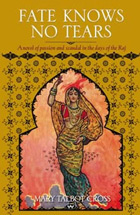
A novel of passion and scandal in the days of the Raj
Mary Talbot Cross
'Pale hands I loved beside the Shalimar,
Where are you now?
Who lies beneath your spell?'
So opens the hugely successful 'Kashmiri Song', set to music in 1902. Yet who today remembers the poet who penned these haunting words?
In Fate Knows no Tears, a romantic novel rich with the colour and pageantry of colonial India, Mary Talbot Cross recreates the life of Violet Nicolson, who found fame as the poet Laurence Hope. Through the pages parade a host of famous - and infamous - individuals.
Violet Nicolson, courageous, outspoken and dangerously attractive, lived through times of dramatic change in both India and England. Her own life was no less challenging or exciting. For five years she shared her soldier husband's adventures on the wild mountains of what is now Pakistan. Later, in Central India, her embrace of native customs and the behaviour previously indulged by Nicolson's regimental colleagues became the stuff of scandal; there was even talk of a native lover ...
When Violet Nicolson published three volumes of poetry in which she evoked echoes of India's fascinating past, her passionate accounts of forbidden liaisons and sensuous jasmine-laden nights sent shock waves through polite Edwardian society.
Mary Talbot Cross is a pseudonym of Jennifer M.T. Carter. Jennifer M.T. Carter grew up in the United Kingdom and took an honours degree in French language, literature and civilization at Aberdeen University in Scotland. She is an independent researcher and writer, and the author of Painting the Islands Vermilion: Archibald Watson and the brig Carl, Eyes to the Future: Sketches of Australia and her neighbours in the 1870s, and Burra 1845-1851: A Directory of Early Folk. Research for her historical novels (written as Mary Talbot Cross) has taken her to England, India and France. As well as travel, she lists among her interests gardening and the pursuit of the eccentric.